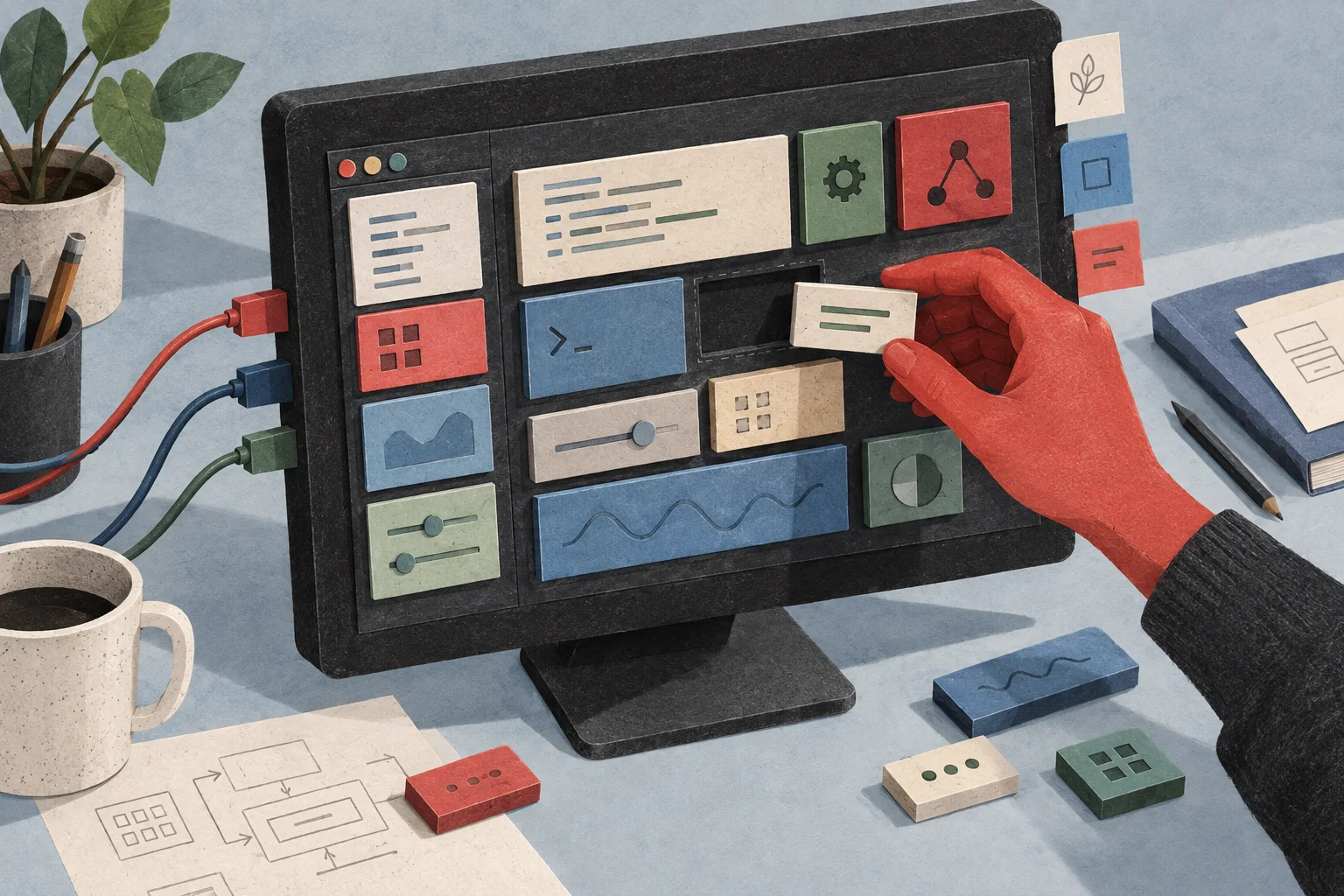
The agent interface is becoming something people can shape themselves.
In a 1 October post, Boris Cherny described Claude mods as a way to customise both behaviour and appearance through prompting, then share those changes as plugins. The idea is more personal than a new setting: people with different workflows do not have to use the same interface.
That turns a useful local adjustment into a shareable artifact. A team can compare how it asks for work, how it sees progress and how it reviews results. The interesting question is whether those changes make the work easier to understand, not simply whether the interface looks different.
The terminal becomes a canvas
Edwin Arbus offered a playful example on 2 October: a Claude Code mod that plays video with sound inside a terminal. He described each frame as 195,000 coloured glyphs, using foreground and background colours for extra fidelity.
It is an entertaining demonstration of how far a familiar surface can be stretched. The more practical implication is that the shape of an agent's workspace is becoming something a user can change. A terminal need not be limited to the stream of messages it originally exposed.
That creates room for more useful experiments: a view of the files changed, a persistent list of checks still running, or a clearer handoff when the agent needs a decision. These are possibilities suggested by the idea, rather than features established by Arbus's demonstration. The test for any of them is whether the user can follow the work more easily.
Reading is part of the workflow
Andrej Karpathy's post the following day puts a useful counterweight beside that enthusiasm. As people spend more time understanding language-model output, he points to asking for explanations in ASD-STE100, a controlled-language specification, as one technique he has found helpful.
It is a small experiment: take an explanation you already have and request a version with constrained vocabulary and sentence structure. Then compare what became clearer and what nuance disappeared. A fluent explanation can still be wrong; a clearer one should make its claims easier to check.
For a code change, that could mean asking the agent to explain the trigger, the resulting behaviour, the evidence from its checks and the uncertainty that remains. That is an editorial suggestion for reviewing work, rather than a claim that a language constraint makes a model more reliable.
The demand for that visibility is already appearing in developers' accounts of agent use. In a 2 October post, Geoffrey Huntley described feeling comfortable leaving one system unattended and compelled to watch another. His account is personal experience, not a comparison test. It captures a question that interface designers have to answer: what would someone need to see before they felt able to step away?
Personalisation and legibility belong together. A workflow can feel perfectly tailored while making its decisions difficult to inspect. The strongest customisation gives the reader a better grip on the work.